
Edwin Ao's Chlorophyll Hexagons Is a Quiet Lesson in the Art of Letting Go
At BENCH Fashion Week Holiday 2026, the Cebuano designer uses solar printing and sharp tailoring to show what happens when a garment learns how to remember.
By Kobe Janer
October 1, 2026
Edwin Ao is a fine arts graduate of the University of San Carlos, a renowned Cebuano fashion designer, and an instructor at the UP Cebu College of Communication, Art, and Design. He has shown in Paris, Tokyo, and Singapore, and if there is a constant in his work it is that every line has a reason. On September 26 at BENCH Fashion Week Holiday 2026, he built something meant to come apart.
Chlorophyll Hexagons: The Body in Impermanence is his answer. "I want to explore the relationship between nature, transformation, and the human form," he shares. He describes personal evolution as something that asks a person to let go of every identity, memory, and perception they are holding, to make room for whatever comes next. The collection is what that letting go looks like when it is made into something a person can wear.

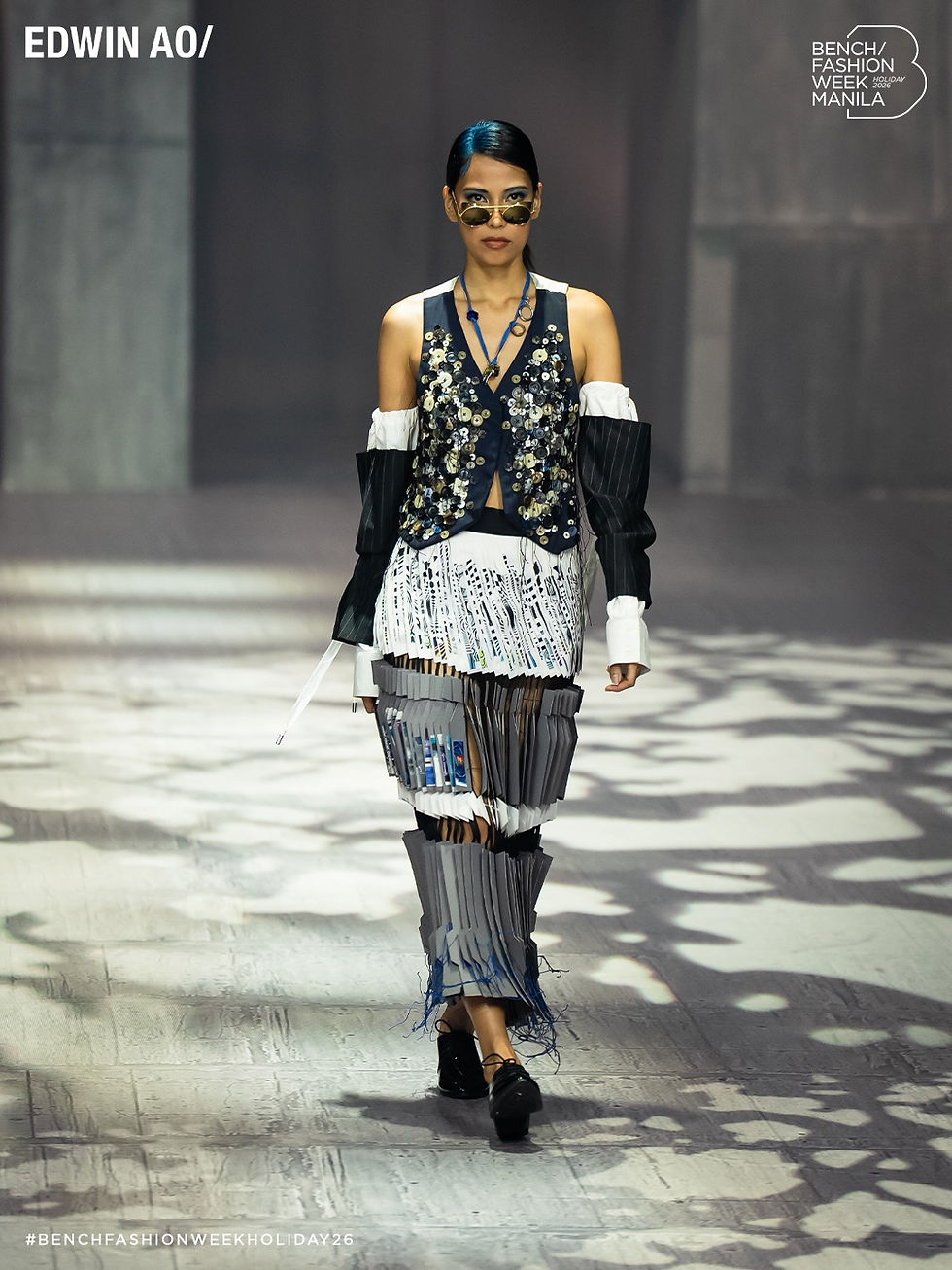
The tailoring is precise in the way only someone who has spent years with fabric can make it, sharp lapels, clean shoulders, a suit that knows what it is, and then it starts giving its secrets away. A navy blazer opens at the chest to reveal a circuit board wired into the lapel with loose red cable and a monocle on ribbon, the inside of a garment suddenly made visible. Buttons cluster across a top and down to the shoes, so many that they stop being closures and become something closer to skin. Pleated skirts hold their shape and then fracture into dense printed strips, which takes more care to build than a clean finish ever would. A sheer top carries match-like embellishments, each one dangling at a different length so the whole surface moves when the model breathes. Every piece on that runway was precise enough to fall apart on purpose.


Solar printing sits at the center of the process, and it matters because it takes the final design completely out of human hands. Ao lays fabric under direct sunlight with chlorophyll pressed into it, and the sun does the printing. The exposure leaves behind organic traces, shapes, and shadows that belong entirely to that exact moment, depending on the time of day, the angle of light, and how long the cloth stays out. Each printed strip carries a slightly different record of the same process, the way two photographs taken a minute apart will never look exactly the same. He then takes images from his own smartphone, photographs he has constructed and deconstructed, and reassembles them into what he calls "a new visual language, suggesting that identity is never fixed, but continually reconstructed through experience, memory, and selection." The result is fabric that has already been through something before it becomes a garment.


That is also the clearest way to understand what the tailoring is doing. A structured jacket splitting to reveal wiring, a pleat breaking into pattern, a top trailing loose fringe, each piece looks like something caught in the act of turning into something else, and every one of them is still becoming something.
"I wanted to bring this idea to the collection, to propose a contemporary expression of renewal that celebrates the body and impermanence," he shares. He laid fabric under the sun and pressed chlorophyll into it, letting nature do the marking, and what came back was a record of one day's light that no other day could reproduce. That is the whole collection in one gesture, a designer trusting that what changes is more beautiful than what stays the same, and it reminds everyone sitting there exactly why art matters in the first place.


Photos courtesy of BENCH


Comments